

Tair Salakhov, Yerbolat Tolepbay and other academicians
Tair Salakhov, Yerbolat Tolepbay and other academicians

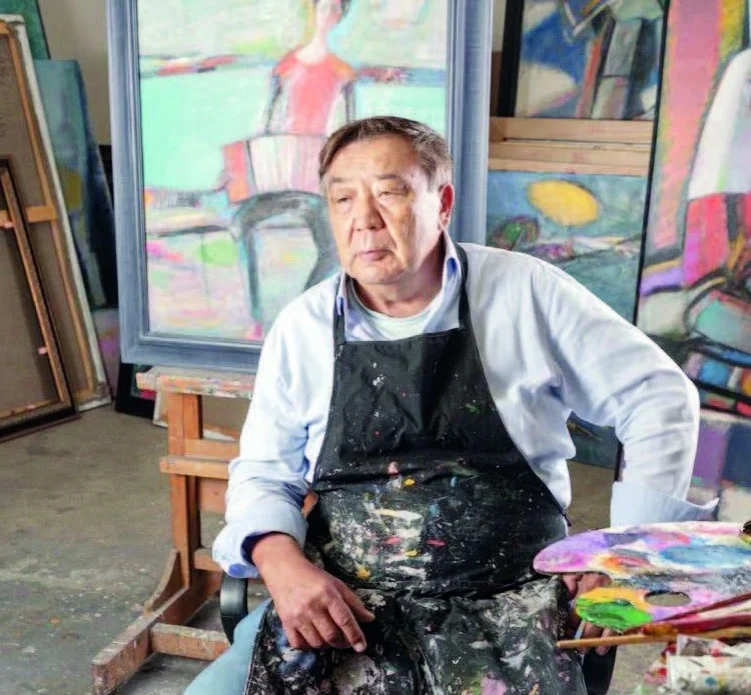
Yerbolat Tolepbay on Kazakhstan, Baku, and the eternal values of humanity
*** Yerbolat Tolepbay was born in 1955 in the city of Kaskas, South Kazakhstan Region. He is an Honored Artist, winner of the State Prize, and academician of the art academies of Kazakhstan, Russia, the Czech Republic, and Kyrgyzstan. In contemporary world art, he is considered one of the most prominent representatives of surrealism and one of the most talented followers of the great Spanish artist Salvador Dali. His titles and awards are so numerous that listing them all would fill an entire page.
Morning. Sunbeams play softly on the glass shop windows, the air is fresh and warm. We head to the White Tulips Garden, opposite the Azerbaijan State Puppet Theater. There are a few minutes left before our appointment with the outstanding Kazakh artist Yerbolat Tolepbay. The clock shows almost ten o'clock, and we are glad that we made it on time.
We look around. The tables are neatly arranged outside the cafe, and our distinguished guest is sitting at one of them. We already know the artist from photos on the Internet. Our eyes meet, and he invites us to sit down with a kind, friendly smile. He is the first to start the conversation.
“I have visited, perhaps, half of the countries in the world,” he says. “But nowhere else have I drunk tea as delicious as in Baku. And your cuisine is amazingly rich and refined. No wonder they say that Azerbaijan is a paradise on earth!”
Yerbolat Tolepbay is rightly called a living legend of modern Kazakh visual art. He is only a year and a half older than me. On October 2 this year, he turned 70, and the anniversary was celebrated with great fanfare in Astana. His exhibition “The Way to the Temple,” featuring 65 paintings, opened at the National Museum of the capital. At the ceremony, the Chairman of the Senate of Kazakhstan noted the important place and role of the jubilarian in the cultural life of the Kazakh people.
He is a surprisingly simple, cheerful man. His manner of speaking and carrying himself, his kind and sincere words, reveal an inner light, a special energy and charisma of a true artist.
We ask him how many times he has been to Baku, and it turns out we are mistaken.
“This is my first time in this beautiful city,” he smiles. "I have many friends here, and they have been inviting me to visit them for a long time. Thank God, it finally happened. I have been here for several days now, and I must say that the people of Baku are amazingly sincere, kind, and honest.
The words of the world-famous artist about our capital and its hospitable residents are like balm for the soul. What can we say to our distinguished guest? Tell him that we have heard many times about the brilliant successes of Kazakhstan during its years of independence—a country stretching across endless, fertile expanses? Or remind him that during the years of Stalin's repressions, the Kazakhs shared their last piece of bread with Azerbaijani families exiled to the steppes, saving many from starvation and death? We have heard about this from eyewitnesses of those difficult times.
Or perhaps we should remember how in January 1990, when the Soviet military machine was shooting people shouting “Freedom!” in the streets of Baku, the great Kazakh poet and deputy of the Supreme Soviet of the USSR, Olzhas Suleimenov, hurriedly arrived in our city and boldly raised his voice in protest against the Kremlin? The author of the book “Az and I” erected an eternal monument to himself in the heart of every Azerbaijani.
Of course, we couldn't help but share these thoughts with our guest. He listened attentively, with approval, and his eyes shone with warm gratitude. And we even forgot for a moment that we had come here to conduct an interview.
And suddenly a question came to mind...
“Do you think sound has color?”
As if expecting this question, he smiled in response:
"Sound, words, even thoughts and feelings themselves have thousands of shades. For example, the voices of true, sincere friends are blue. Like the color of our Caspian Sea — yours and ours...
“But we have seen the Caspian Sea dark, almost black — when it is angry...”
“That means someone hurt it then,” he replied with a gentle smile. "But now, I hope, no one will hurt this beautiful sea anymore. May the waters of the Caspian Sea become a bridge of friendship and brotherhood between the peoples and states that live on its shores.
"As far as we know, your father was a party worker. How did you become interested in painting at a young age?
"My older brother, Tokbolat, was a very talented artist, a folk master. It was he who ignited the first sparks of love for this art in my soul. Unfortunately, my brother did not live long - he passed away at a very young age.
There is a momentary pause between us. The artist himself breaks the silence:
“There is one thing that still pains my heart today,” he says quietly. “Journalists often ask me for a photo of me with my late brother. But I couldn't find a single one in our family album... And yet we were so close, so friendly...”
- I would like to hear your thoughts on your creative credo...
- Like all creative professionals, artists have only one true goal: to bring joy to people through their work, to purify and uplift their souls, to make life more beautiful. For me, a genuine person is someone who carries a sense of mercy in their heart, thoughts, and actions. Those who do not have kindness in their souls easily succumb to the devil's schemes and become his slaves.
I am convinced that every genuine painting, every enchanting melody, every profound book that nourishes the soul and mind protects humanity from evil and enriches people internally. It is with this belief that I create each of my new canvases.
I also believe that people and societies deprived of faith in God pose a danger to humanity. But religion must go hand in hand with culture. If any society strives for development and progress, it must take this important principle into account.
Your philosophy of life is close and understandable to us. Let me ask you one more question. Art critics conditionally divide your work into two periods. In their opinion, you devoted the first twenty-five years of your career, that is, until the 2000s, to creating large-scale, multifaceted canvases, while in recent years your attention has focused on the inner world of man and his spiritual experiences. How do you feel about such assessments?
I think my art historian friends are generally right. But it is difficult, and sometimes impossible, to define the boundaries of creativity. Regardless of the genre or direction to which a particular work of mine can be attributed, each piece is dear to me. The main thing is that it awakens humanistic feelings in the hearts of those who come into contact with it.
Meanwhile, the waiter refills our tea. We sip strong, aromatic tea with lemon and listen intently to our interlocutor. He, inspired and with particular enthusiasm, discusses the most subtle aspects of his life and creative philosophy:
“You know,” he says, "an artist must be able to illuminate the light that lives in the soul of his people. I try to show the whole world Kazakhstan — my homeland, the spirit of my people, who have roamed the endless steppes for centuries, a people who have always thirsted for freedom, created and built.
It was once said that “only great peoples can create great literature.” The brilliant Chingiz Aitmatov dispelled this misconception with his entire brilliant creative career. Today, there is probably no writer on earth who is read more than him.
It is also interesting that not only in literature or art, but also in big politics, relatively small nations have managed to produce outstanding statesmen. I think that Azerbaijan's current brilliant successes are based on the titanic efforts of a great personality - Heydar Aliyev.
Incidentally, dear Heydar Aliyev and our Nursultan Abishovich (referring to Nazarbayev - author's note) were close friends. Fortunately, this wonderful tradition is being continued by the current presidents of Azerbaijan and Kazakhstan - Ilham Aliyev and Kassym-Jomart Tokayev.
Recently, the current occupant of the White House, Donald Trump, called Ilham Aliyev and Turkish President Recep Tayyip Erdogan great politicians. And these are the words of the leader of America, a country considered to be the world's center of power. When we heard about this in Kazakhstan, we were sincerely delighted. We know that Turkey and Azerbaijan will always stand by the Kazakh people in difficult times. And we, the Kazakhs, share the same beliefs. In our turbulent and turbulent times, it is extremely important for the Turkic states and peoples to preserve and develop the traditions of brotherhood and unity.
- In your interviews, you have often spoken warmly of the outstanding artist Tair Salakhov. If you would be so kind, please share with our readers your thoughts about this great master...
- With great pleasure. Tair Salakhov was my teacher and mentor. He was not only a great artist, but also a man of rare heart and amazing kindness. Let me give you one example. It was 1987. As they say, one thing led to another - it was a warm autumn day, just like today. The then Minister of Culture of Kazakhstan and I were in New York at an event. Before leaving for home, we stopped at a store and, I must admit, were drawn to the video players. Neither I nor the minister had one at the time. We wanted to buy one, but we didn't have enough money—in Soviet times, people traveling abroad were only allowed to exchange a pittance of foreign currency.
When we left the store and headed for the park across the street, we saw two elegantly dressed men get out of an expensive car. At first, I thought they were millionaires, maybe even relatives of Rockefeller. We were about twenty meters apart when one of them suddenly called out to me:
“Yerbolat, my dear, how wonderful that you are here too!”
It was Tair Salakhov. Standing next to him was the world-famous sculptor Zurab Tsereteli. We hugged each other. When he learned that we didn't have enough money to buy a video player, Tair Salakhov took all the money out of his pocket and literally forced it into my hand. He said, “I'm flying to Moscow tomorrow, and I won't need dollars there.” That's the kind of person Tair Salakhov was—a real man, noble to the core.
“Tomorrow (our meeting took place last Saturday), you are flying to Ankara. If it's not a secret, what are your plans in our brotherly country?”
“I was invited to a conference on the development of painting in the Turkic states. Perhaps they will praise me a little on the occasion of the anniversary (smiles).” A few years ago, when a terrible earthquake struck brotherly Turkey, I was deeply shocked. To the extent that I was able, I provided material assistance to the affected families. I am not saying this for self-promotion — it was simply my human duty. If possible, I would like to visit the disaster area.
- Thank you very much for the sincere conversation!
- Thank you too. Let's take a commemorative photo. In recent years, wherever I go, I always take photos with my friends.
Ilgar GUSEYNOV,
Masim ABDULLAEV,
especially for the newspaper
“Baku Worker”
I am convinced that every genuine painting, every enchanting melody, every profound book that nourishes the soul and mind protects humanity from evil and enriches people internally. It is with this belief that I create each of my new paintings.